


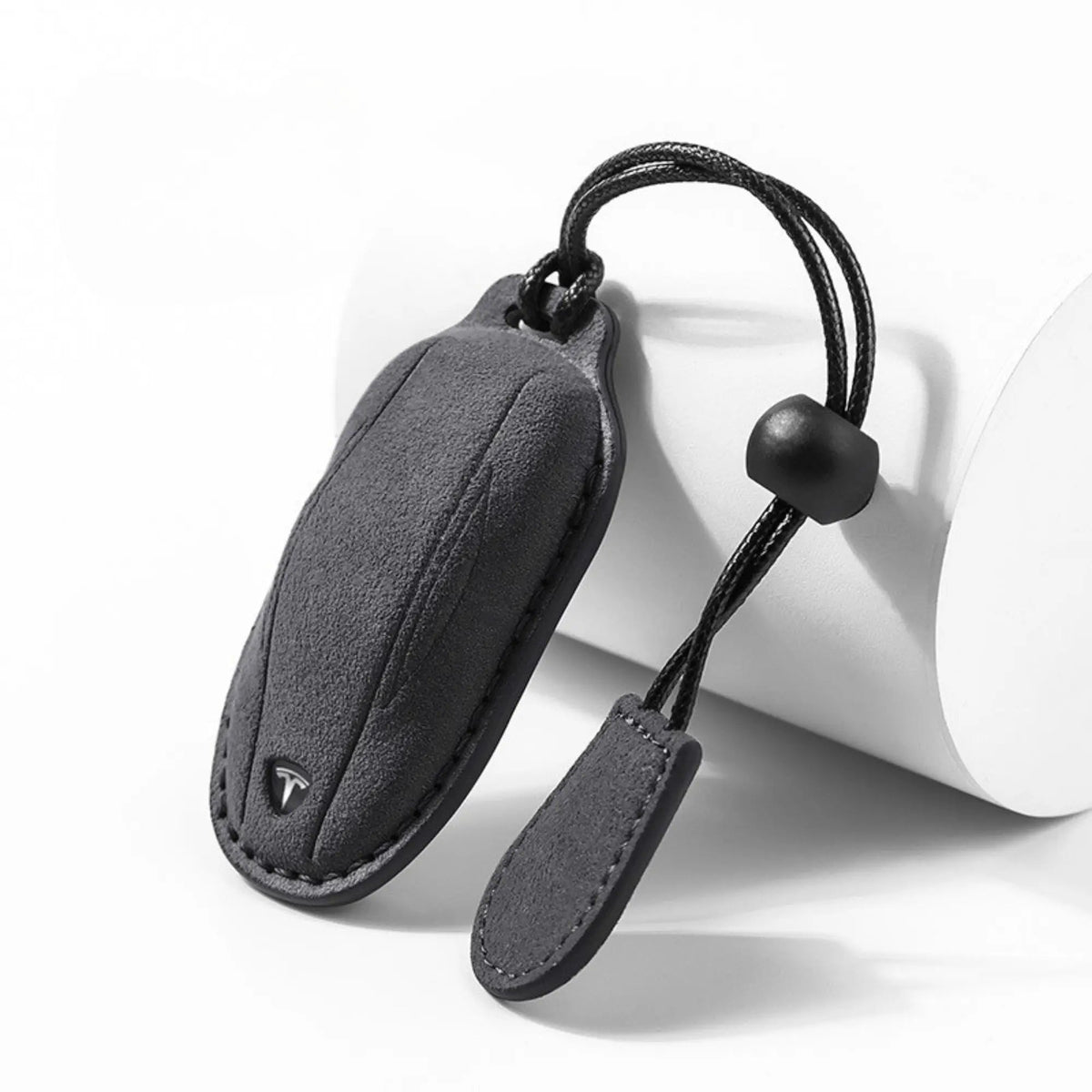
The short answer: Model 3 and Model Y ship with a flat NFC key card and the fob is an optional extra. Model S and Model X ship with the car-shaped fob. The card is the one most owners lose, because it has nothing to grip and nothing to attach it to - a suede sleeve fixes both problems without stopping the card working.
How each one actually works
The key card is NFC. You hold it flat against the reader on the B-pillar, behind the driver's door handle, and again on the center console to enable driving. It has no battery, so it never goes flat - but it also has no range. It only works when it is touching the car.
The key fob is a radio key shaped like the car. It unlocks as you approach, has a coin cell inside, and lets you open the boot or frunk without touching the screen.
Most owners also use their phone as the day-to-day key and keep the card as a backup. That backup is exactly the thing that gets lost, because it lives in a wallet and looks like a credit card.
The card's three failure modes
- It slides out. A bare card in a coat pocket has no friction. This is the single most common way owners lose one.
- It gets confused with a bank card. Handed to a valet, left in a card machine, put in the wrong slot.
- It flexes. Sat on in a back pocket over months, the antenna inside can fail. There is no repair - it is a replacement.
A sleeve solves the first two directly: grip so it stays in the pocket, and a visual difference so it is not mistaken for a card. Adding a keyring or a strap solves the third by keeping it out of a back pocket.
Does a sleeve stop the card being read?
No. Suede and leather are non-conductive and NFC passes through them. Hold the sleeve flat against the reader exactly as you would the bare card. If the car does not read it first time, move it an inch and hold still a second longer - which is the same thing that happens with a bare card in a crowded wallet.
What does interfere: metal card holders, and RFID-blocking wallets. Those are designed to stop exactly this, so keep the Tesla card out of them.
The fob's failure modes
- The coin cell. Typically a year or so. The car warns you.
- Drops. The fob is glossy plastic and shows every scuff.
- Button wear. The double-press zones lose their crispness on older fobs.
Which to protect
| You drive | You carry | What helps |
|---|---|---|
| Model 3 or Y | Phone + card backup | Card sleeve with a keyring, so the backup stays findable |
| Model 3 or Y | Optional fob | Fob cover, plus a sleeve for the card in the glovebox |
| Model S or X | Fob | Fob cover - it is the part that gets dropped |
Common questions
Can I add a keyring to the card? Not to the card itself - punching a hole through it can cut the antenna. A sleeve with a ring is the safe way.
How many cards can I have? Teslas ship with two. Extras can be added in the car's settings; check what your model and software support.
Does the card work if the car's 12V battery is dead? No. The reader needs power, which is why the mechanical door release exists.
Is the phone key enough on its own? Most days, yes. Until the phone is flat - which is precisely when the card you cannot find becomes the problem.
We make suede covers for both: see Tesla Alcantara key covers and card sleeves, or the full Tesla key cover range.

Hinterlasse einen Kommentar
Diese Website ist durch hCaptcha geschützt und es gelten die allgemeinen Geschäftsbedingungen und Datenschutzbestimmungen von hCaptcha.